

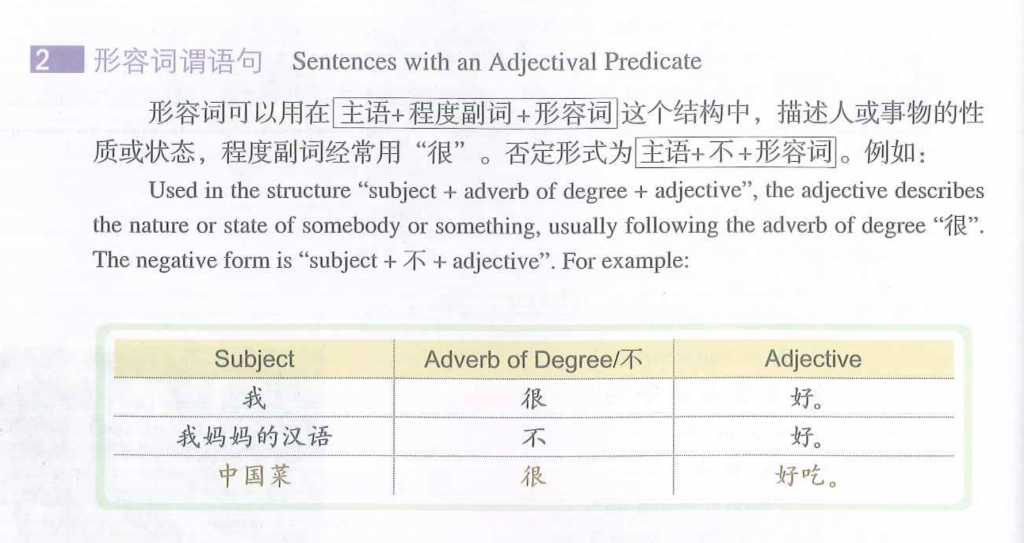
In English, nouns can be “linked” to adjectives and other nouns with the verb “to be.” In Chinese, nouns are linked to other nouns in one way, but linked to adjectives in a completely different way. Nouns are linked to other nouns with 是 (shì). Nouns are linked to adjectives with 很 (hěn).
Structure
Noun + 很 + Adj.
The noun in this structure is the subject of the sentence. Sometimes the 很 (hěn) in this structure is translated as “very,” but often it is just a way to link a noun to an adjective.
Examples
In the following examples, 很 (hěn) is just a link (you could think of it as a substitute for the verb “to be”), and the sentences could be translated as “(Noun) is (adjective).”
我 很 好。
Wǒ hěn hǎo.
I’m good.
你 很 漂亮。
Nǐ hěn piàoliang.
You are pretty.
他 很 高兴。
Tā hěn gāoxìng.
He is happy.
中文 很 难。
Zhōngwén hěn nán.
Chinese is difficult.
老板 很 生气。
Lǎobǎn hěn shēngqì.
The boss is angry.
我们 很 累。
Wǒmen hěn lèi.
We’re tired.
我 哥哥 也 很 高。
Wǒ gēge yě hěn gāo.
My older brother is also tall.
你 家 也 很 远 吗?
Nǐ jiā yě hěn yuǎn ma?
Is your house also far away?
爸爸 很 忙,妈妈 也 很 忙。
Bàba hěn máng, māma yě hěn máng.
Dad is busy, and mom is also busy.
他 和 他 弟弟 都 很 帅。
Tā hé tā dìdi dōu hěn shuài.
He and his younger brother are both handsome.
Remember that 是 (shì) is not used to link adjectives to nouns. This is a classic mistake that almost everyone makes when learning Chinese. Make sure you use 很 (hěn) and not 是 (shì) to link adjectives to nouns, as shown below:
他 是 高。❌
Tā shì gāo.
他 很 高。
Tā hěn gāo.
He is tall.
What 很 (hěn) Really Means
If you’re like most learners, when you first learn this pattern, you’re thinking, “How can 很 (hěn) mean “very” one minute, but then nothing but a “link” the next? How do I know if anything means anything in this language?” That’s a reasonable response. But in the case of these “Noun + Adj.” sentences, you just have to think of this usage of 很 (hěn) as an exception. It’s just part of the structure.
If you actually want to add the meaning of “very” into the sentence, you could use another adverb instead of 很 (hěn). One good choice is 非常 (fēicháng).
他 非常 高 。
Tā fēicháng gāo.
He is very tall.