

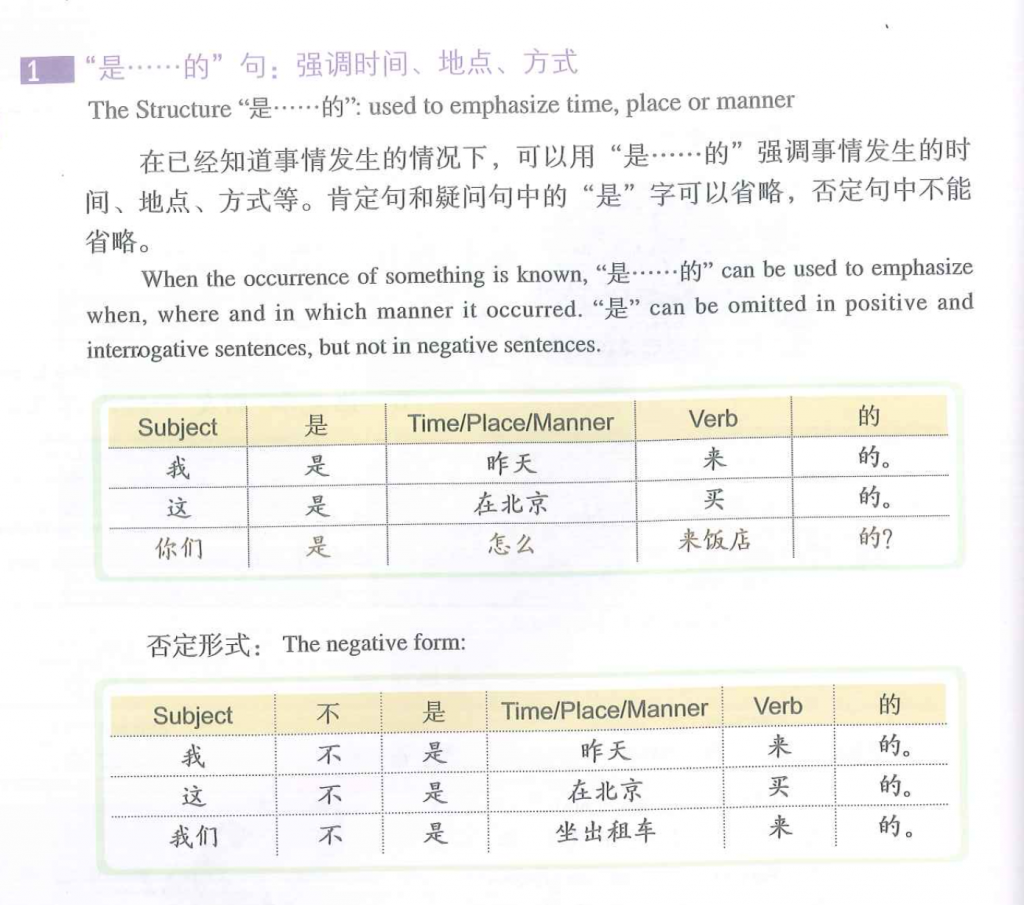
one common question I get asked is :Why there is a “的” at the end of a sentence like “我是在云南出生的-I was born in Yunnan”, a simple explanation can be : it` s a fixed structure to emphasize a specific detail , in this case “在云南-in Yunnan” is emphasized !
The 是⋯⋯的 (shì… de) construction is used to draw attention to certain information in a sentence. It’s often used to ask questions that seek specific information, or to explain a situation by emphasizing a particular detail. While not strictly tied to any “tense,” the 是⋯⋯的 construction is frequently used when asking or telling details about the past.
Even if you understand that 了 is not used to mark “past tense” in Chinese, it’s possible that you incorrectly use it that way sometimes. For example, what if you want to ask a question about something that happened in the past? Would you ever say one of the following sentences?
你 昨天 几点 到 了 ?❌
Nǐ zuótiān jǐ diǎn dào le?
What time did you arrive yesterday?
你 跟 谁 去 了 ?❌
Nǐ gēn shéi qù le?
Who did you go with?
他 用 什么 打 你 了 ?❌
Tā yòng shénme dǎ nǐ le?
What did he use to hit you?
In each of these sentences above, 了 is not the right choice, because you’re not asking if an event happened or not. You’re asking about details of past events. When you are singling out details for emphasis–in a question or a statement–you need to use the 是⋯⋯的 construction.
是⋯⋯的 construction can pick out any detail that’s related to a past event. Whatever comes immediately after 是 is emphasized. Check out this example:
A: 昨天 我 去 杭州 了。
Zuótiān wǒ qù Hángzhōu le.
I went to Hangzhou yesterday.
B: 你 是 怎么 去 的 ?
Nǐ shì zěnme qù de?
How did you get there?
A: 我 是 坐 火车 去 的 。
Wǒ shì zuò huǒchē qù de.
I went by train.
Now let’s revisit those other three sentences and ask the questions correctly with 是⋯⋯的:
你 昨天 是 几点 到 的 ?
Nǐ zuótiān shì jǐ diǎn dào de?
What time did you arrive yesterday?
你 是 跟 谁 去 的 ?
Nǐ shì gēn shéi qù de?
Who did you go with?
他 是 用 什么 打 你 的 ?
Tā shì yòng shénme dǎ nǐ de?
What did he use to hit you?