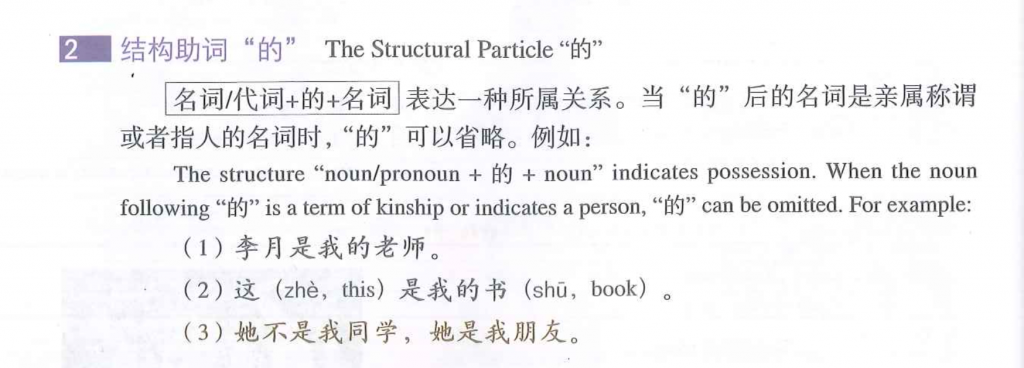
Besides what has been said above , you can also omit 的 (de) in the following case:
An institutional or organizational relationship is involved (school, work)
我们 学校 很大 。
Wǒmen xuéxiào hěn dà.
Our school is big.
他们 公司 在 昆明。
Tāmen gōngsī zài kūnmíng.
Their company is in kunming.
In these cases 的 (de) should be omitted. It doesn’t sound as natural if you leave it in.If 的 (de) was used in the above examples, it would create an unnatural sense of distance between the two.
Modifying nouns with adjective + “de”
With a Noun Structure
A very common way to modify nouns is to attach an adjective to them using 的 (de).
Adj. + 的 + Noun
This structure comes up extremely frequently and is an easy way to attribute features to nouns. Occasionally you will see this 的 (de) omitted, but note that if the adjective has two characters (e.g. 漂亮 (piàoliang) or 高兴 (gāoxìng)), the 的 (de) is generally required.
Examples
漂亮 的 女孩儿
piàoliang de nǚháir
beautiful girl
辣 的 菜
là de cài
spicy food
可爱 的 宝宝
kě’ài de bǎobao
a cute baby
他 常常 买 便宜 的 东西。
Tā chángcháng mǎi piányi de dōngxi.
He often buys cheap stuff.
Without a Noun Structure
In some cases, it is possible to drop the noun from the pattern, and just use the adjective + 的 (de). This is kind of like saying “the big one” or “the red one” in English. In Chinese the 的 (de) serves the same purpose as the English word “one.” By using this pattern, you can avoid repeating the same noun over and over again unnecessarily. Just be sure the other person is already clear which “one” you’re referring to when using this pattern!
Adj. + 的
Examples
A: 孩子 喜欢 吃 什么 东西 ?
Háizi xǐhuan chī shénme dōngxi?
What food do children like to eat?
B: 甜 的 。
Tián de.
Sweet food.
A: 你 喜欢 哪 种 女孩?
Nǐ xǐhuan nǎ zhǒng nǚhái?
What kind of girls do you like?
B: 漂亮 的。
Piàoliang de.
Pretty ones.
A: 你 要 喝 冷 水 还是 热 水?
Nǐ yào hē lěng shuǐ háishì rè shuǐ ?
Do you want to drink cold or hot water?
B: 冷 的。
Lěng de.
Cold.