

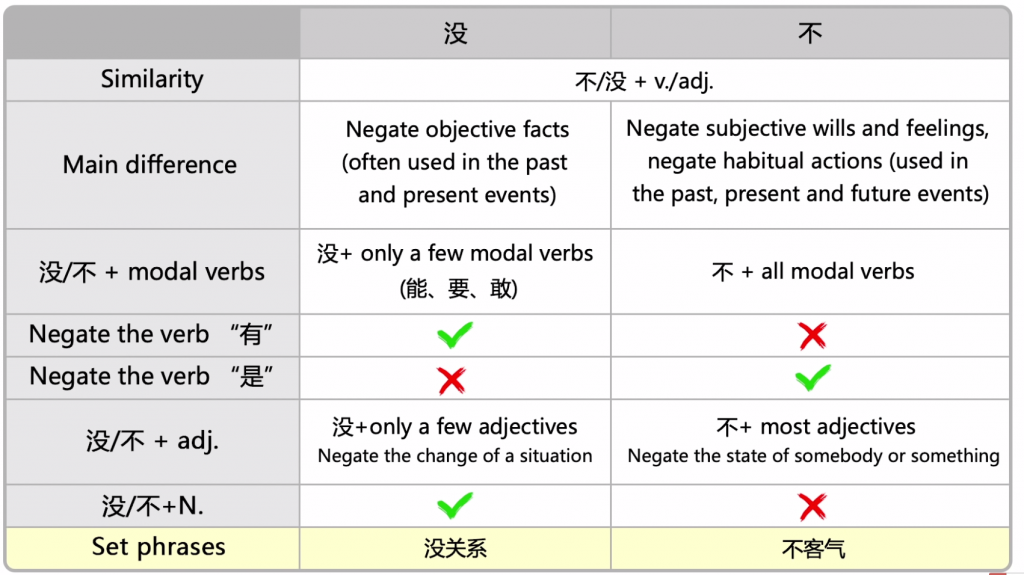
(一)时间限制 上不同 -Differences in time limits
“不”用于主观意愿,可指示过去,现在和将来。-“不” is used for subjective will (and feelings) and can indicate the past, present and future.
比如
我昨天不舒服。(A feeling in the past tense ~ I didn’t feel well yesterday)
“没”因为否定动作的发生,所以只用于过去和现在。-“没” is only used in the past and present because of the negative action。
比如:
我没去北京。 (a past negative action ~ I didn’t go to Beijing). 我不去北京。- I am not going to Beijing. ~~将来时
我今天没跑步。 ( a non action – I did not run today)
(二)主观角度上的不同-Subjective differences
“不”否定主观意愿,既包括动作发出者做某事的意愿,也包括说话者的主观评价和认识。-“不” denies subjective will, including both the sender’s willingness to do something and the speaker’s subjective evaluation and recognition.
比如:
我明天不去学校。(tomorrow I will not go to school) thought process = I do not have the will to go to school tomorrow – also future.
“没”否定客观事实,即动作的发生,进行,完成,或过去的经历。-“没” denies objective facts, that is, the occurrence, progress, completion, or past experience of actions.
比如:
这个手机没坏。- This is an objective fact, this phone is not broken.
她昨天没来学校 – Objective fact, she did not come – cannot refute – not subjective. Also, specific stated time (refer below)
(三)动静状态上的不同-Differences between dynamic and static state
“不”否定的是词性成分本身,是静态的否定。-“不” negates the part-of-speech component itself, which is static (state of being ~ 不 = negative state of being) (think English am/was/be) negation.
比如:
我不饿。 (hunger = a state of being; I am not in the state of being hungry; I (am) not hungry)
State of being does not change regardless of tense
昨晚我不累。
去年我不高兴。
今早我不渴。
“没”否定的是词性成分所表示的事物,时间的状态或存在,是动态的否定。-“没” negates what is represented by the part-of-speech component, the state or existence of time, is a dynamic (action with no definitive endpoint 比如 jump(跳tiao4) /swim/wash/swing ~ 没) negation.
比如:
我今天没跳绳。 state or existence of time ,it’s a negative action 但是如果我不跳 (i don’t jump) , it`s either 我不会跳 (I can’t jump) = state of being -( I, as a person, do not jump. ) or I, as a person, cannot jump) so : I didn’t jump = 没 ; I don’t jump/ I can’t jump = 不
练一练
1.来到中国以前,我一句汉语也( )会说。(过去,否定会(会议))-Before coming to China, I couldn’t speak a sentence of Chinese. (In the past, negate it)
2.小时候,我对唱歌( )感兴趣。(过去,主观)-As a child, I was not interested in singing. (Past, subjective)
3.我( )收到回信,可能他出差了。(现在,动态)-I didn’t receive a reply, maybe he was on a business trip. (Now, dynamic)
4.我们来得太早了,花还( )开。(现在,动态)-We came too early and the flowers have not yet bloomed. (Now, dynamic)
5.他从( )说假话,大家都很信任他。(现在,习惯)-He never tells lies, and everyone trusts him. (Now, habit)
-你说过这句话?
-没说过。
6.他刚才( )吸烟。(过去,主观)-He didn’t smoke just now. (Past, subjective)
7.衣服还( )干,还要继续晒晒。(现在,动态)-The clothes haven’t dried yet, and you have to keep on drying. (Now, dynamic)
8.这个地方( )干净,换个地方吧。(现在,静态)-This place is not clean. Let`s change it. (Now, static)
答案:1-8: 不,不,没,没,不,没,没,不。